
Teaching, Learning, & Outcomes
5-7 Minute Read
Author: Bruce Morgenstern, MD
Purpose
To provide a framework for COM faculty members to understand the best practices, the jargon, and the fundamentals of medical student education so that students can maximize their learning.
Learning Objectives
Distinguish teaching and learning;
Identify the relative roles of pedagogy and definition of pedagogy; and
Outline the evolution toward outcomes-based education.
There are many reasons that we’re taking this opportunity to help you develop as a faculty member at Roseman and anywhere else you may teach. Among those reasons are:
You all “teach” a lot more than you realize every day of your lives – you’re looked upon as experts and people do listen to you.
Students pay a relative fortune in tuition nowadays and they deserve faculty who know what they’re doing.
The body that accredits medical schools expects it.
It’s fun for us.
It’s food for thought for you.
Let’s start with some simple concepts.

First, what is teaching? Merriam-Webster offers this useless and circular definition of teaching as a noun: “1. the act, practice, or profession of a teacher, 2: something taught.”(1)
Let’s see how they define the verb “to teach”:
General: To cause to know something, e.g., taught them a trade:.
To cause to know how, e.g., is teaching me to drive.
To accustom to some action or attitude, e.g., teach students to think for themselves.
To cause to know the disagreeable consequences of some action, e.g., I’ll teach you to come home late.
To guide the studies of.
To impart the knowledge of, e.g., teach algebra.
Or this:
To instruct by precept, example, or experience.
To make known and accepted, e.g., experience teaches us our limitations.
To conduct instruction regularly in, e.g., teach school.
The definitions for the verb “to teach” certainly are more comfortable for most of us, but they miss something – the point of teaching. Isn’t the point of teaching to facilitate learning? If you spent hours “teaching” something, and the learners didn’t actually learn whatever it was, did you really teach?
In the old days, much of medical education, at least for medical students and residents, was documented by time spent in an environment. So, irrespective of what you learned, as a student or resident, you’d “pass” if you passed an exam (who even knew how good that assessment instrument was) and spent X hours or weeks in, say, a biochemistry class, or on a dermatology rotation. It was all about the teacher.
Second, what’s pedagogy? Merriam-Webster says it’s “the art, science, or profession of teaching.”(2) The word comes from the French, who adapted it from Latin, who adapted it from Greek, where it meant “education, attendance on boys” (are we surprised at the gender bias?). Interestingly, pedagogue, the teacher, apparently comes from the Greek and had the meaning “slave who escorts boys to school and generally supervises them.”(3) (There’s something vaguely unnerving about that definition.)
Pedagogy (the science of teaching) is at the core of many programs that offer bachelor’s and master’s degrees in education. But let’s think about this briefly.
Let’s use, as an exemplar, Anne Sullivan and Helen Keller; the latter, of course, was born deaf and blind. The former was the person who, in a major breakthrough, taught Ms. Keller to communicate. Ms. Sullivan graduated from a school for the blind (she herself was visually impaired, apparently from trachoma) and a year later, she was hired by the Kellers to teach Helen.
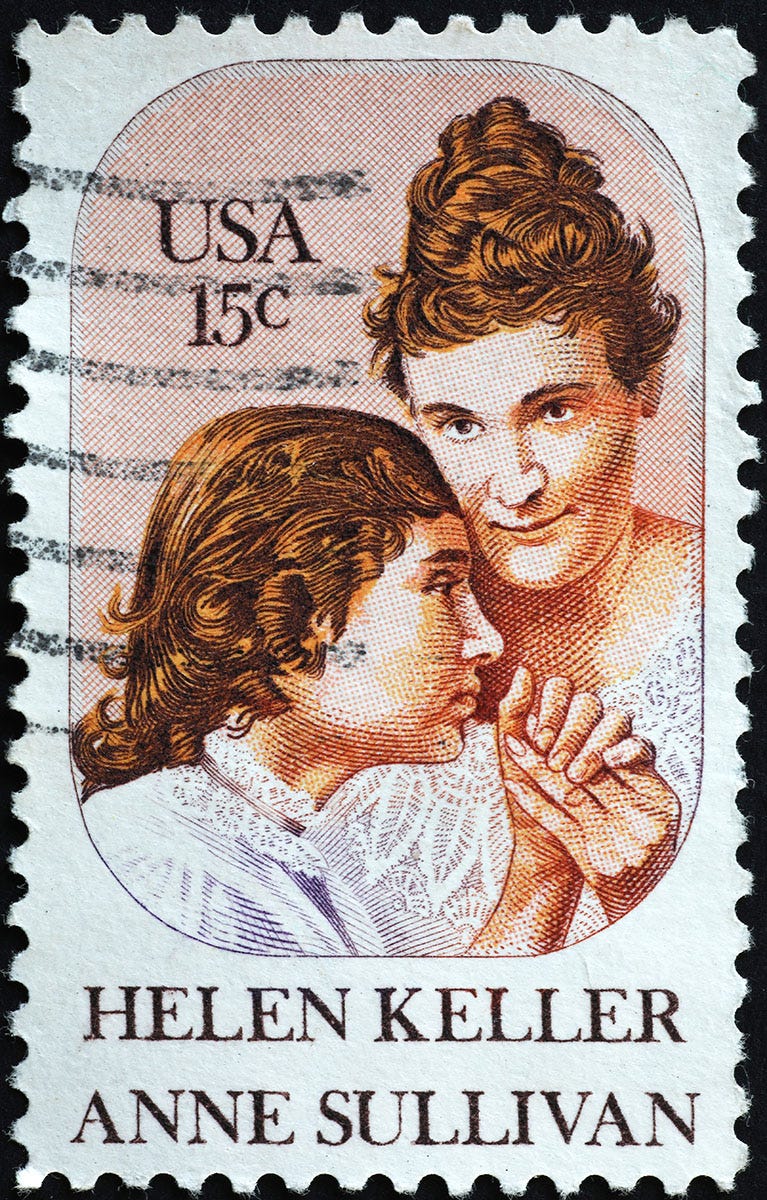
Although Ms. Sullivan was a “teacher” of the blind and befriended one of the first deaf-blind people in the US to “learn” while at school (so Ms. Sullivan had a mentor of sorts) there was no “pedagogy” for what she did. There were no lesson plans from which she could work, yet she succeeded in “teaching” Ms. Keller. Basically, the teacher (Ms. Sullivan) and the student (Ms. Keller) developed approaches that worked. (Of course they worked, if they had not worked, who’d ever have known about them?) It wasn’t the pedagogy which was being created on the fly, it was the outcome – Helen Keller learned to communicate.
If you’ve never heard of Helen Keller (we can perhaps forgive not remembering who Anne Sullivan was), check out the 1962 Oscar-winning movie The Miracle Worker – yes, it’s from 1962 and yes, it’s in black and white, but still!
Lastly, what is outcomes-based education? Perhaps the emphasis should not be on what schools provide to students, but rather on what the students have learned. This has come to be known as outcomes-based education (OBE), a concept at least 40 years old. Tenets often include:(4)
Creation of a curriculum (we’ll come back, in future modules, to the concepts of syllabus and curriculum) that outlines specific, measurable outcomes.
A commitment not only to provide the “teaching,” but to require learning outcomes for advancement. Promotion or graduation is granted upon achieving the standards. Extra classes, repeating an experience, or other consequences are offered to those who do not do so.
Standards-based assessments. Students must demonstrate that they have achieved the stated standard. Assessments may take any form, so long as they are reliable and valid tools.
A commitment that all students will ultimately reach the same minimum standards.
In health professions education, much later than for K-12 education from which the above was generated, this concept has become known as Competency-Based Education. Competency is not quite a real word. It stems from competence, of course, which is a noun that means possession of sufficient knowledge or skill. Competence, in the world of medical education has come to be a gestalt – “they’re competent to be a pediatrician.” Competency has come to be associated with specific skills – “they’ve achieved competence at the competency of professionalism.”
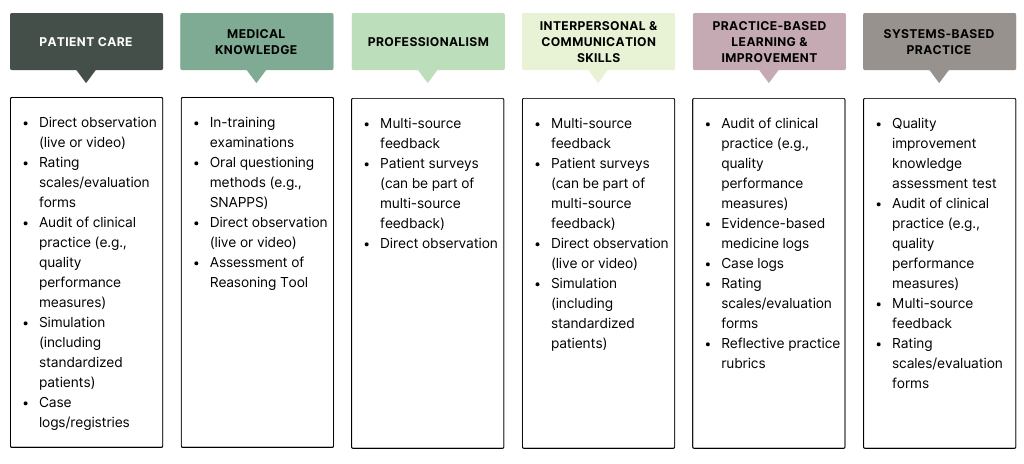
The Accreditation Council for Graduate Medical Education (ACGME) in 2020 published a comprehensive document about competencies and the AGCME’s next steps in competency-based education, namely, milestones. (5) The table below lists the six competencies that have been developed and rolled out by the ACGME. Note that the competencies are also accompanied by methods to assess them – remember these are the outcomes the learners are supposed to acquire (learn), not simply have been taught.
Common Assessment Methods for the Six Core Competencies
References
Merriam Webster. “Teaching” definition & meaning. Accessed May 3, 2022. https://www.merriam-webster.com/dictionary/teaching
Merriam Webster. “Pedagogy” definition & meaning. Accessed May 3, 2022. https://www.merriam-webster.com/dictionary/pedagogy
Etymology, origin and meaning of “pedagogy.” etymonline.com. Accessed May 3, 2022. https://www.etymonline.com/word/pedagogy
K12 Academics. What is outcome-based education? k12academics.com. Accessed May 3, 2022. https://www.k12academics.com/education-reform/outcome-based-education/what-obe
Edgar L, McLean S, Hogan SO, Hamstra S, Holmboe ES. The Milestones Guidebook v. 2020. ACGME; :41. Accessed May 3, 2022. https://www.acgme.org/globalassets/MilestonesGuidebook.pdf