
Goals & Objectives
3-5 Minute Read
Primary Author: Bruce Morgenstern, MD
Purpose
To provide a framework for clincal educators to understand the best practices, the jargon, and the fundamentals of medical student education.
Learning Objectives
Explain the importance of goals and objectives in education.
Really? This module has only one learning objective?
Yup. This element is the foundation of all that follows and, to some degree, the natural outgrowth of the briefs on the science of learning and at the essence of the concept of teaching versus learning we covered in Teaching, Learning, and Outcomes.
1. To frame this a bit better, think (not too hard) about the following three statements by some famous people:
Steven Covey – “begin with the end in mind”
Lewis Carroll – “If you don’t know where you are going, any road will get you there.
Yogi Berra (probably not, actually) – “If you come to a fork in the road, take it.”
[Again, we can forgive some of you for not recognizing all three names. Here are some Wikipedia links, if you need to know – and you should: Steven Covey, https://en.wikipedia.org/wiki/Stephen_Covey, Lewis Carroll (which was a pen name), https://en.wikipedia.org/wiki/Lewis_Carroll, and Yogi Berra, https://en.wikipedia.org/wiki/Yogi_Berra, check out the “Yogi-isms” section.]
2. All health professional education schools need to be accredited by two different accrediting bodies (it’s OK to fall asleep here): one regional body that accredits colleges and university, and one specific to the degree being awarded, so for an allopathic medical school in the US, it’s the Liaison Committee on Medical Education (LCME).(1) The degree-specific accrediting bodies all expect overall goals and objectives for the graduate of the school. The LCME does not specify which goals/objectives, just that a medical school have them in place, guiding the curriculum and the measures of the student competence.(2)
Two common approaches for medical schools are to use either the Physician Competency Reference Set (PCRS) or Entrustable Professional Activities (EPAs). The PCRS competencies (remember that concept from Teaching, Learning, and Outcomes) parallel the AGCME competencies and add “Interprofessional Collaboration” and “Personal and Professional Development,” so there are eight broad categories and many more under each broad category.(3) The other option US medical schools are using are the list of “Entrustable Professional Activities” [We know, entrustable isn’t really a word either, much like competency, but that hasn’t deterred the powers that be].(4)
3. A brief tangent:
This next piece gets confusing, and don’t worry, there won’t be a test on it…. Most, if not all, US allopathic Medical Schools belong to the Association of American Medical Colleges (AAMC). The AAMC developed both the PCRS and the EPAs. Hence both links refer back to the AAMC. The “Liaison” in LCME relates to the fact that the LCME is co-owned by the AAMC and the American Medical Association, hence the need to liaise…
4. OK, we can’t resist, a 2nd tangent:
Deep philosophical arguments, battles between strategic planning consultants and marketing experts have developed over the distinction between goals and objectives. We do not wish to belabor this, but surely some of you are linguists after a fashion and may be plagued by our relatively loose use of the terms. This is for you—from the University of Iowa Center for Teaching:
“Goals are general statements about what you hope students will gain from your course such as, “Students will gain an understanding of …” or, “Students will develop an appreciation of …” (5)
“Objectives are more specific statements that include both an action verb and a content reference. They can be assessed through class activities and assignments.”(5)
The Harvard-Macy Institute has a helpful #MedEdPearls: A Primer on Learning Objectives that suggests using the SMART framework for writing learning objectives:
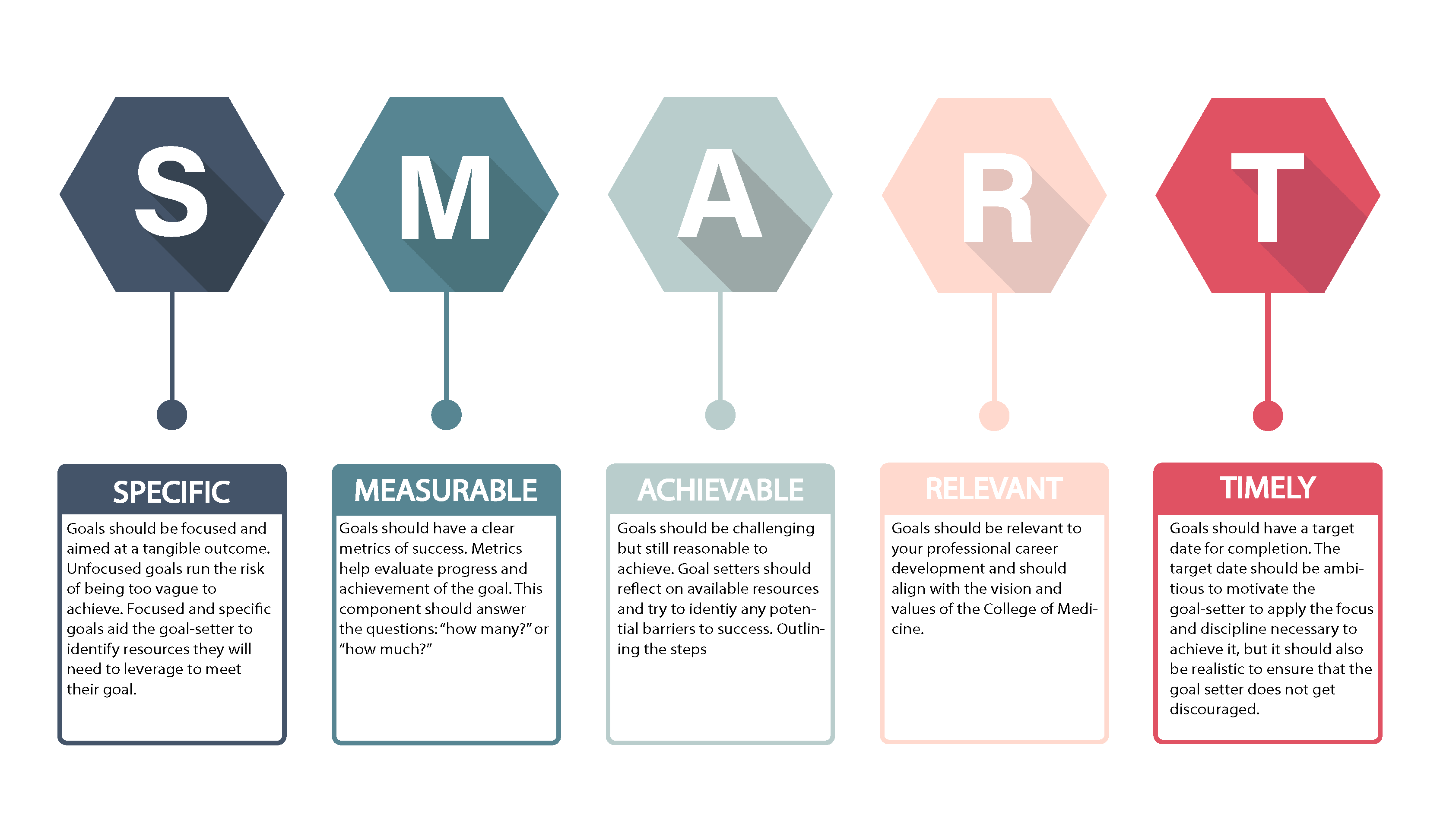
Surely you’ve noticed that each module begins with learning objectives. Arguably, we have drafted the objectives to be able to be assessed.■
References
Liaison Committee on Medical Education. Programmatic Accreditation vs. Institutional Accreditation. Accessed November 22, 2022. https://lcme.org/about/programmatic/
Liaison Committee on Medical Education. Functions and structure of a medical school: standards for accreditation of medical education programs leading to the MD degree(link downloads a Word document). March 2020. Accessed November 22, 2022. https://lcme.org/wp-content/uploads/2022/07/2023-24_Functions-and-Structure_2022-03-31.docx
Association of American Medical Colleges. Curriculum inventory: physician competency reference set (link downloads an Excel spreadsheet). Accessed November 22, 2022. https://www.aamc.org/what-we-do/mission-areas/medical-education/curriculum-inventory/establish-your-ci/physician-competency-reference-set
Association of American Medical Colleges. The core entrustable professional activities (EPAs) for entering residency. Accessed November 22, 2022. https://www.aamc.org/what-we-do/mission-areas/medical-education/cbme/core-epas.
University of Iowa Center for Teaching. Syllabus goals vs. objectives(Link downloads a .pdf document). Access November 22, 2022. https://teach.its.uiowa.edu/sites/teach.its.uiowa.edu/files/docs/docs/Goals_vs_Objectives_ed.pdf